
PMI has a significant global supply chain, and our approach to sustainable supply chain management includes a set of Responsible Sourcing Principles (RSPs), which define expectations for our suppliers and their suppliers too.
Our supply chain due diligence system aligns with the UNGPs. We aim to continue working with our business partners to proactively identify, manage and reduce risks, and create shared value.
Manufacturers of electronic devices for
heated tobacco products and e-cigarettes are fairly new to our supply chain. Formal assessments of these tier-1 suppliers found that most of them aligned with our RSPs, although some had issues that needed to be resolved—primarily recruitment
practices and the living conditions of migrant workers.
In parallel to our RSP process, specific sustainability risks of our tobacco supply chain are addressed through our Good Agricultural Practices (GAPs),
structured around four key pillars—governance, crop, environment and people. We expect all those who grow and supply tobacco to PMI to meet these principles and measurable standards.
Responsible Sourcing Principles
The Responsible Sourcing Principles document is the foundation of our collaboration with our suppliers and value chain partners. It outlines requirements to ensure a long-term sustainable supply that protects the environment and enhances livelihoods within our value chain. It is also closely aligned with PMI’s Code of Conduct and clearly outlines the minimum criteria that suppliers must adhere to in order to work with us.
PMI launched the first version of the Responsible Sourcing Principles (RSPs) in 2017. In 2023, we updated the document to embed sustainability trends and to reflect changes in the evolving sustainability-related regulatory landscape. The updated version is also aligned to the latest PMI ambitions and updated PMI Code of Conduct and has been simplified and streamlined. The RSP document is divided into two sections.
Section I—Fundamental Principles: These are the principles that are mandatory for the suppliers we do business with. They include:
- Legal compliance and business integrity principles
- Human rights principles
- Environmental principles
- Speaking up
Section II—Guidance and Implementation Tips: In the spirit of continuous improvement, this section contains recommended guidelines and implementation tips relating to the Fundamental Principles designed to support suppliers in developing good practices and driving continuous improvements.
Embracing the RSPs is vital to our mission for PMI to drive positive change across the whole value chain and to align with global sustainability goals and regulations, positioning PMI business for long-term success.
Our RSP document is available in English, which can be downloaded below. Additional versions in different languages are coming soon.
-
RSP العربية - Arabic
-
RSP Bosanski - Bosnian
-
RSP Hrvatski - Croatian
-
RSP Čeština - Czech
-
RSP Français - French
-
RSP Deutsch - German
-
RSP Ελληνικά - Greek
-
RSP Magyar - Hungarian
-
RSP Bahasa Indonesia - Indonesian
-
RSP Italiano - Italian
-
RSP 日本語 - Japanese
-
RSP 한국인 - Korean
-
RSP Македонски - Macedonian
-
PMI Melayu - Malay
-
PMI Polski - Polish
-
RSP Português de Portugal - Portuguese
-
RSP Português (Latino-Americano) - Portuguese (Latin American)
-
RSP Română - Romanian
-
RSP Русский - Russian
-
RSP Slovenčina - Slovakian
-
RSP SrpskiСрпски - Serbian
-
RSP Español (Latinoamericano) - Spanish (Latin America)
-
RSP ไทย - Thai
-
RSP Türkçe - Turkish
-
RSP Українська - Ukranian
-
RSP Tiếng Việt - Vietnamese
Our Supplier Due Diligence Framework
We have designed a Supplier Due Diligence Framework to evaluate our suppliers’ status in social, environmental and business integrity compliance and to address gaps within our RSPs and other commitments.
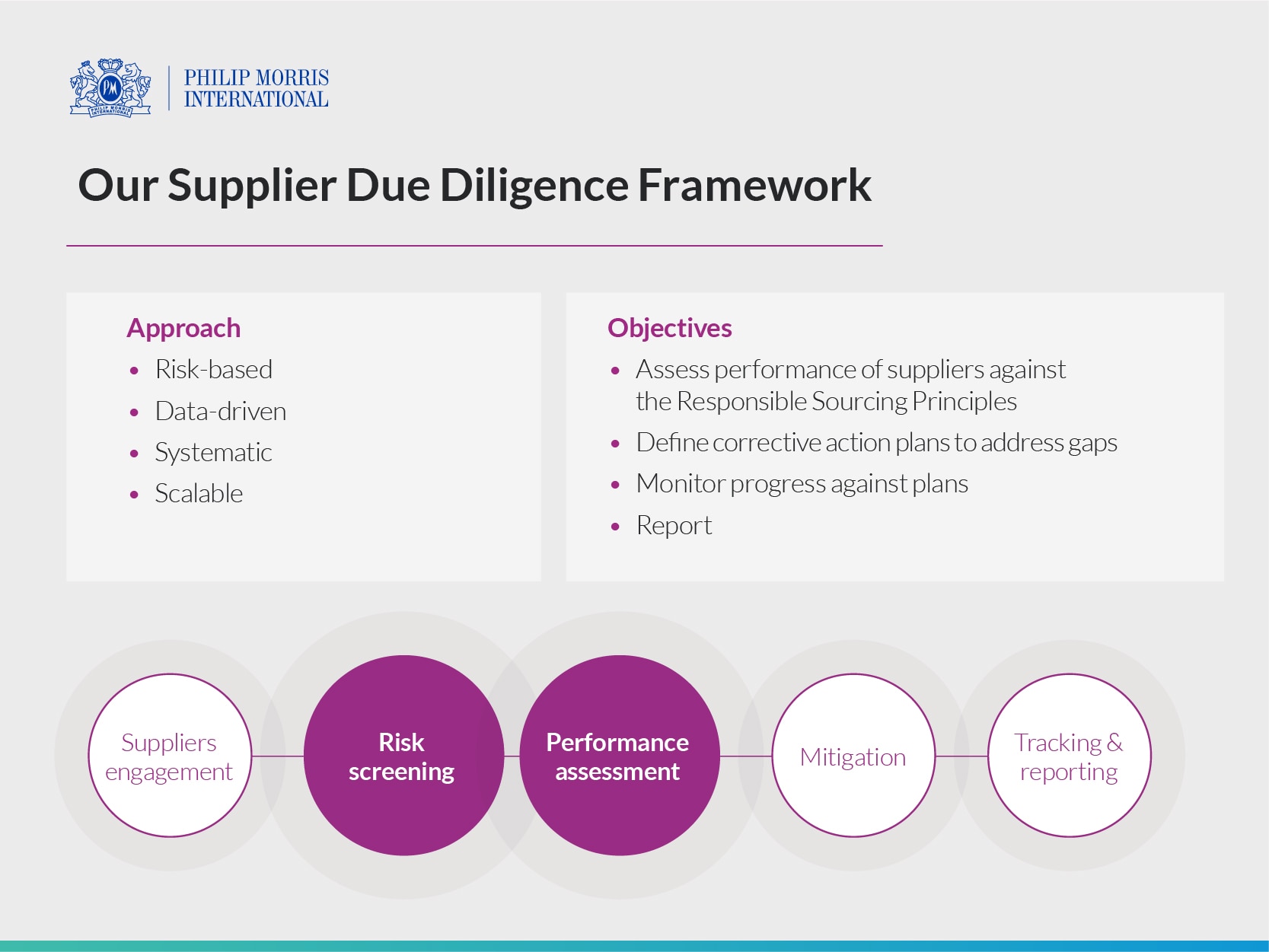
An initial screening of our suppliers according to geography and industry will identify those that should be closely monitored and assessed. Our objective is to support suppliers in a continuous improvement approach to align their practices with our requirements, improving the overall working and living conditions in our supply chain. To deliver our Due Diligence Framework in practice, we have set up an online supplier platform.